
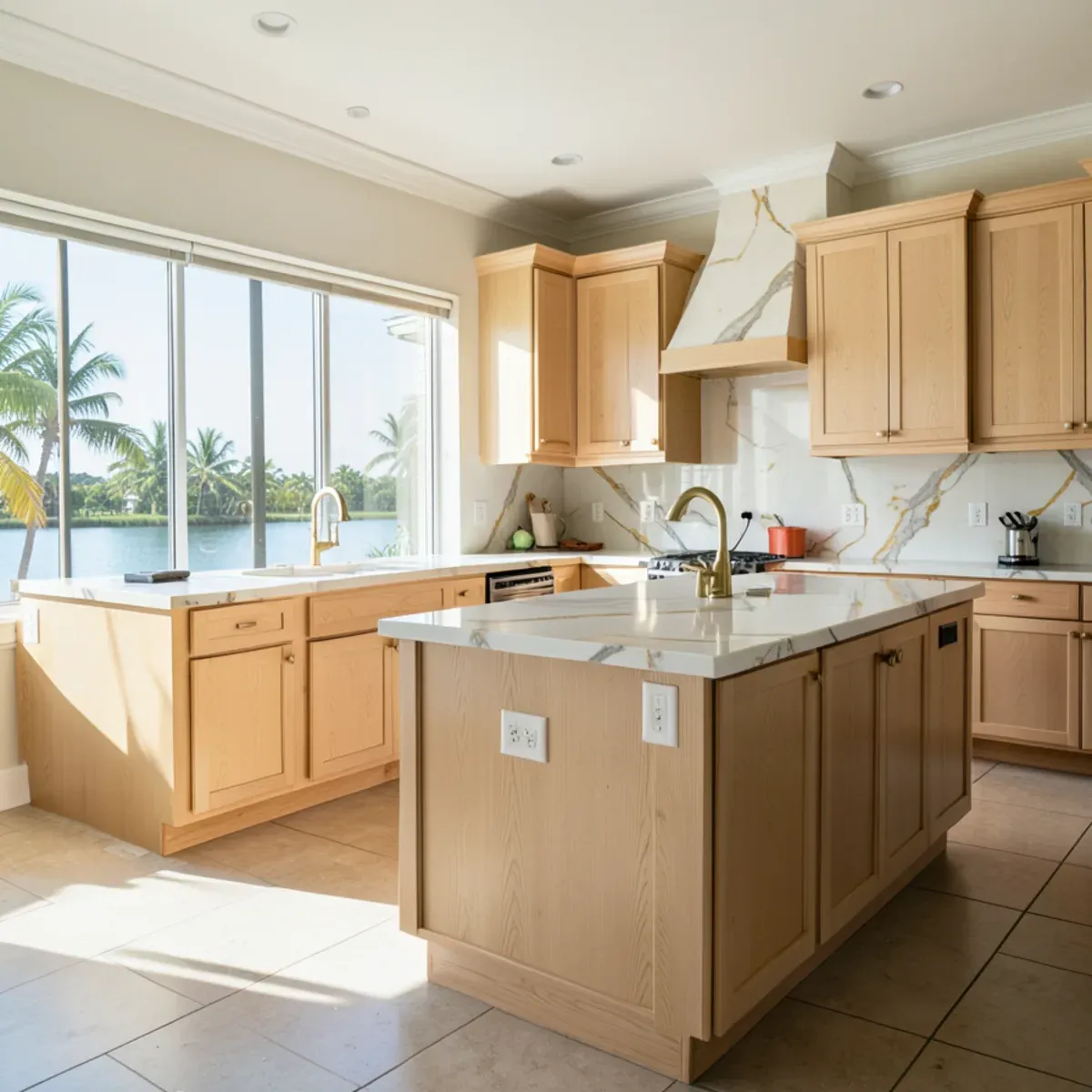
Real marble is natural stone with depth, translucence and a patina that develops with use; marble-look quartz is an engineered, resin-bound slab that copies the veining but does not etch or need sealing. Choose real marble when you want the genuine look and accept etching; choose marble-look quartz when you want a white veined counter with very little upkeep, kept away from hot pans and strong sun.
The white veined kitchen has been popular for years, and quartz makers have answered it with slabs that imitate Carrara and Calacatta closely. From across the room, many people cannot tell them apart. Up close and over time, the two behave very differently.
This comparison covers what each material is, how they handle a working kitchen in Florida, and which situations favor one over the other.
What Is Marble-Look Quartz Made Of?
Engineered quartz starts as ground quartz mixed with polymer resin and pigment, then pressed into slabs and cured. Marble-look styles add veins by layering colored material through the slab or on its surface, depending on the product. Because it is manufactured, the background color is even and the pattern is predictable from slab to slab.
Marble is a natural metamorphic stone formed from limestone, made mostly of calcite. Its veins are mineral deposits that run through the full block, so every slab is one of a kind and the pattern carries through edges and cutouts naturally.
Want a straight answer for your kitchen? Call the shop.
Free in-home estimates · Mon–Fri 7:00–4:30 · weekend estimates by appointment
How Do Real Marble and Marble-Look Quartz Compare Day to Day?
| Factor | Real marble | Marble-look quartz |
|---|---|---|
| Acids (citrus, wine, tomato) | Etches: dull marks where acid sits | Does not etch |
| Staining | Porous; sealing slows stains | Non-porous; resists most stains |
| Sealing | Needed periodically | Not needed |
| Hot pans | Tolerates heat | Resin can scorch or discolor; use trivets |
| Strong sun | Color is stable | Resin can yellow over years in direct UV |
| Outdoor use | Possible but etches and weathers | Most makers exclude it |
| Look up close | Depth and slight translucence; veins vary | Even background; veins can repeat |
| Edges and seams | Veins run naturally through the edge | Edge and seam matching depend on the product |
| Aging | Develops a soft patina | Stays largely the same |
| Repairs | Etches and scratches can be honed and polished | Chips can be filled; scorch marks are hard to fix |
When Is Real Marble Worth It?
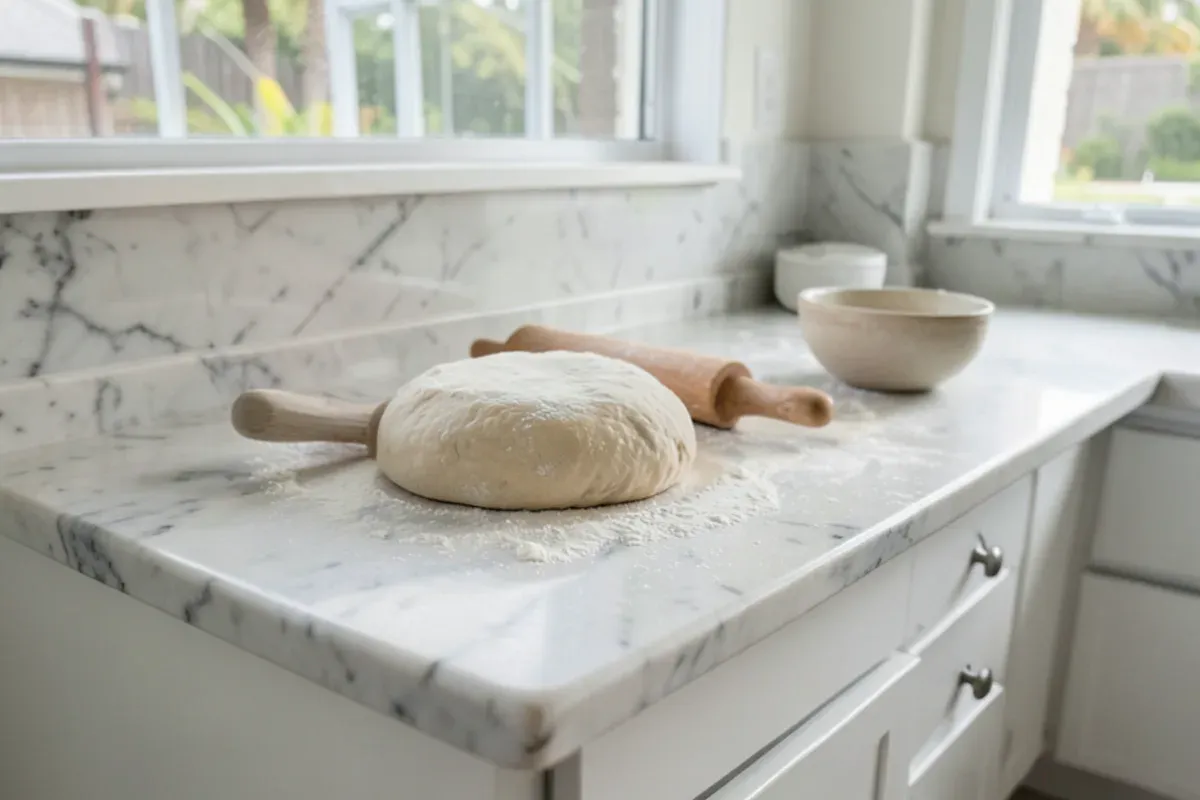
Real marble suits owners who love the stone as it is, marks included. It is a classic baking surface because it stays cool, it handles hot cookware, and it looks right in older or traditional homes where a lived-in patina fits.
- Bathroom vanities, where food acids are rare and marble's weak spot barely matters
- A baking station or a secondary island rather than the main prep run
- Kitchens with strong sun through sliders or skylights, where quartz resin might yellow
- Homes where the authenticity of natural stone is part of the design
Carrara is the most familiar choice and comes honed or polished; our Carrara marble countertops page covers the options. For all of the marble we fabricate, see marble countertops in Fort Pierce.
When Is Marble-Look Quartz the Easier Choice?
Quartz makes sense when the main prep counter takes hard daily use and you want it to look the same for years. Families who cook with citrus and wine, rental owners, and seasonal owners who would rather not think about sealing all fit here.
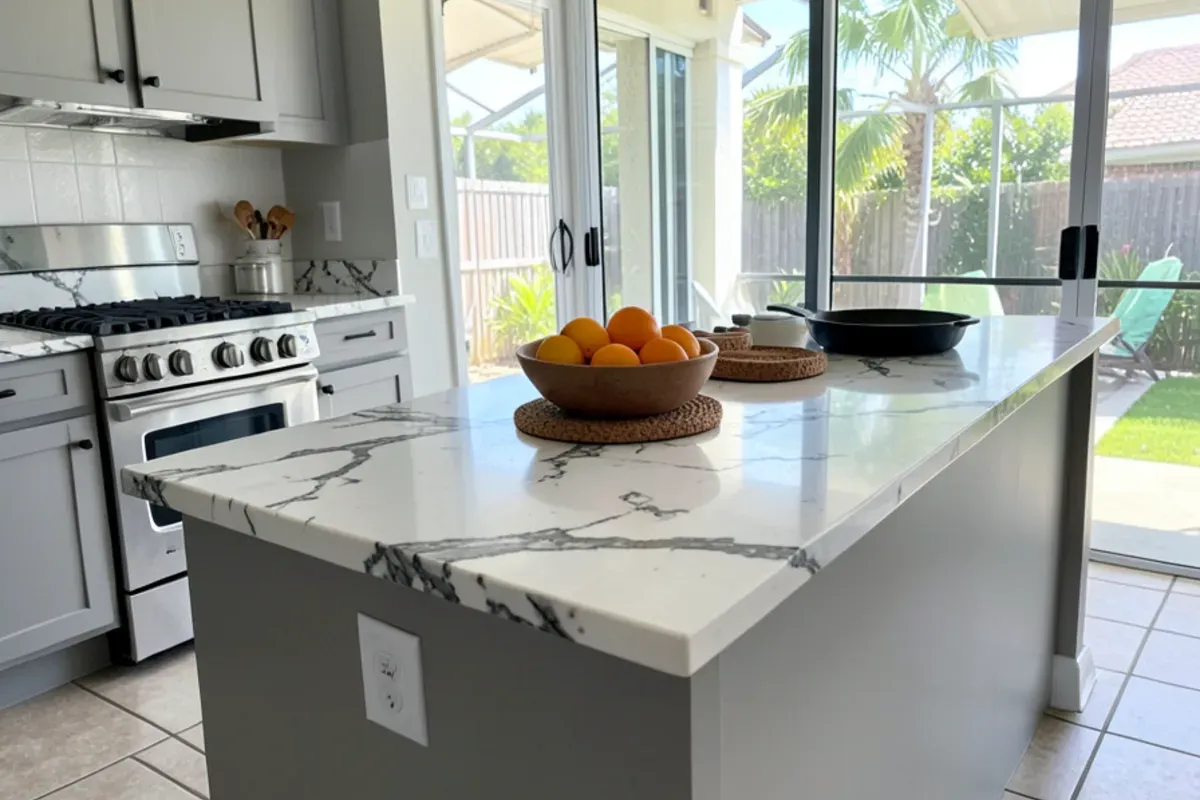
The trade-offs are heat and light. Keep trivets by the range, and think twice about quartz on a counter that sits in direct afternoon sun. Our Calacatta quartz countertops page explains how veined quartz is laid out so the pattern lines up at seams.
Questions to Ask Before You Decide
- How often do you cook with acids, and will you wipe up right away?
- Does the counter get direct sun for long stretches?
- Will hot pans go straight onto the counter?
- Do you want the surface to age, or to stay as installed?
- Is this the main prep counter, an island, or a bathroom?
- Do you need the veins to flow across a waterfall edge or a long seam?
Many homes end up with both: quartz on the busy perimeter and marble on a vanity or a baking island. In the large, bright waterfront kitchens found around Jupiter, that split is worth pricing out.
How Can You Tell Real Marble From Marble-Look Quartz in Person?
Good quartz copies are close enough that labels get mixed up, and stone sold under a trade name is not always what it sounds like. These checks work on a full slab or a sample.
- Follow one vein to the edge. In marble it carries on through the thickness; in many quartz styles the veining sits on the face and fades or changes at the edge.
- Step back and scan the whole slab for a repeating motif. Natural veins never repeat; a pressed pattern sometimes does.
- Look at the back. Marble is usually sawn rough and may carry a mesh backing; quartz backs tend to be even in color and texture.
- Hold a light low across the surface. Marble shows slight depth where light enters the crystals; quartz reads as a flat, even color.
- Ask for an offcut and put a drop of lemon juice on it for a few minutes. Marble dulls where the acid sat; quartz does not.
- Get the material name written on the estimate: marble, quartz or quartzite, not just a color name.
What Does Each Ask of You Over the Years?
The first table compared the two on a single day. Upkeep over time is where the decision usually settles.
| When | Real marble | Marble-look quartz |
|---|---|---|
| First months | Learn where etches appear; run a water test near the sink | Build the trivet habit by the range |
| Every year | Reseal any area where water darkens the stone | Nothing beyond everyday cleaning |
| Every several years | Optional honing or re-polishing of the working areas | Watch counters near sunny windows for any color shift |
| After damage | Etches and light scratches can be refinished in place | Chips can be filled; scorch marks and yellowing are usually permanent |
Marble asks for small, regular attention and can be restored. Quartz asks for almost nothing until it is damaged, and then there is less that can be done.
From Our Shop: Hold Both Samples at Your Own Counter
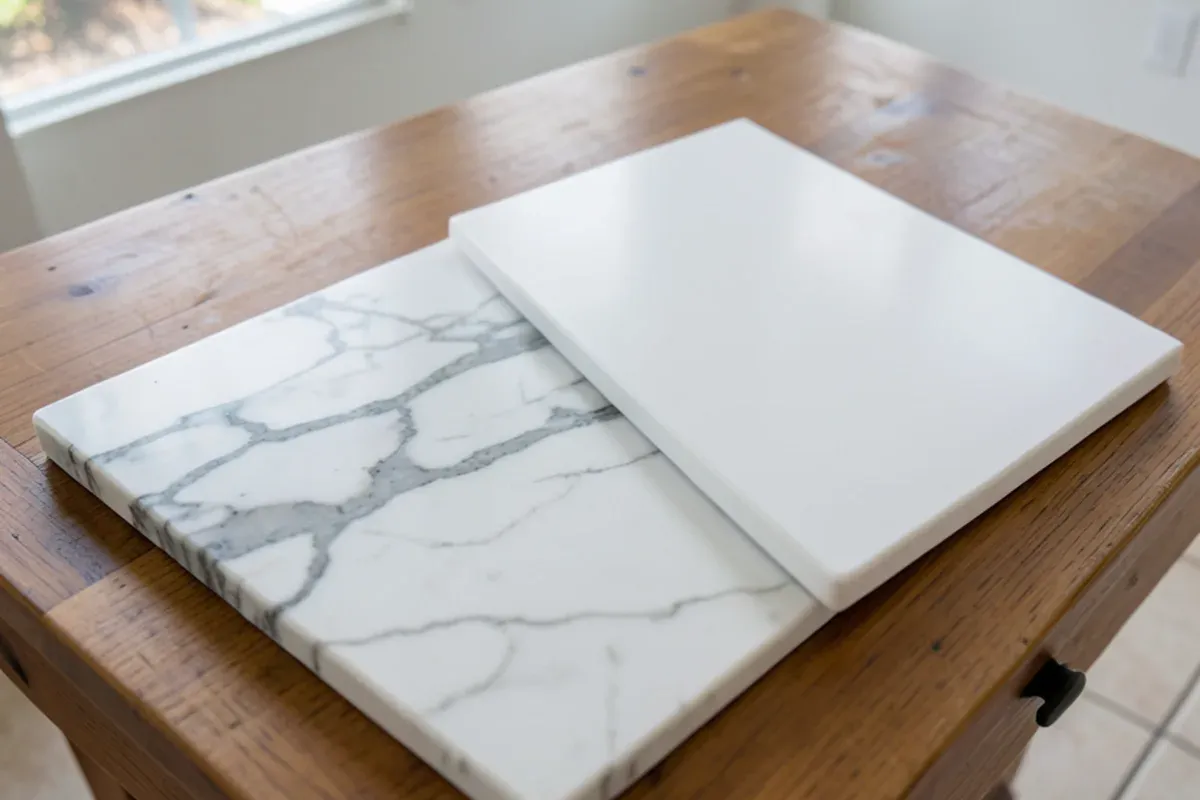
When someone is torn between the two, we suggest setting a marble sample and a quartz sample side by side on the existing counter, in the kitchen's own light, next to a cabinet door. Look from across the room and then from a foot away. The difference most people notice is depth: marble seems to glow slightly, while quartz reads flatter but cleaner.
We also ask how the kitchen is really used. If the honest answer involves lemons on the counter and hot pans set down in a hurry, neither material is perfect, and the choice comes down to which kind of mark bothers you less: an etch on marble or a scorch on quartz.
Waterfall islands raise one more point. Real marble can be bookmatched from consecutive slabs so the veins mirror across the corner; that uses extra stone and needs the slabs reserved together. With quartz, ask whether the veining runs through the body of the slab or only across its face, because that decides whether the pattern can turn the corner cleanly.
Questions We Hear About This
Does marble-look quartz look fake?
Good marble-look quartz is convincing from a few feet away, especially in honed or matte finishes. Up close, the background tends to look more uniform than real stone, and on some slabs the vein pattern repeats. Edges can give it away if the veins stop at the surface. Seeing a full slab, not just a small sample, is the fairest way to judge before we template.
Is real marble more expensive than marble-look quartz?
It depends on the specific slabs. Common marbles such as Carrara can cost less than designer quartz styles with bold Calacatta veining, while rare marbles can cost far more. Fabrication and long-term care also differ: marble needs periodic sealing and occasional polishing. Compare written quotes for the actual slabs you like; we price both after measuring, so the comparison is like for like.
Can marble-look quartz go in a bathroom?
Yes, and it does well there. Quartz resists the lotions, makeup and cleaners that stain or etch marble vanities, and bathrooms rarely see hot pans. The one caution is strong direct sun from a large window, which can yellow resin over many years. Real marble is also a fine vanity choice, since bathrooms have far fewer food acids than kitchens.
Does real marble scratch more easily than quartz?
Yes. Marble is mostly calcite, a soft mineral that a steel knife or a grain of beach sand dragged under a pot can mark. Engineered quartz is built from much harder quartz grains, so everyday scratches are rare. On a polished marble top, fine scratches show in side light; on honed marble they blend in, and both can be refinished. Cut on a board either way.
The Bottom Line
Real marble gives you authenticity and a patina at the cost of etching and sealing. Marble-look quartz gives you a steady, low-upkeep white veined look at the cost of heat and sun sensitivity. Match the material to the counter's job, and do not be afraid to use both in one home.
If you are deciding between the two, book a free in-home estimate with us by phone. We'll look at your light and layout, talk honestly about how each will wear, and put both options in writing.