
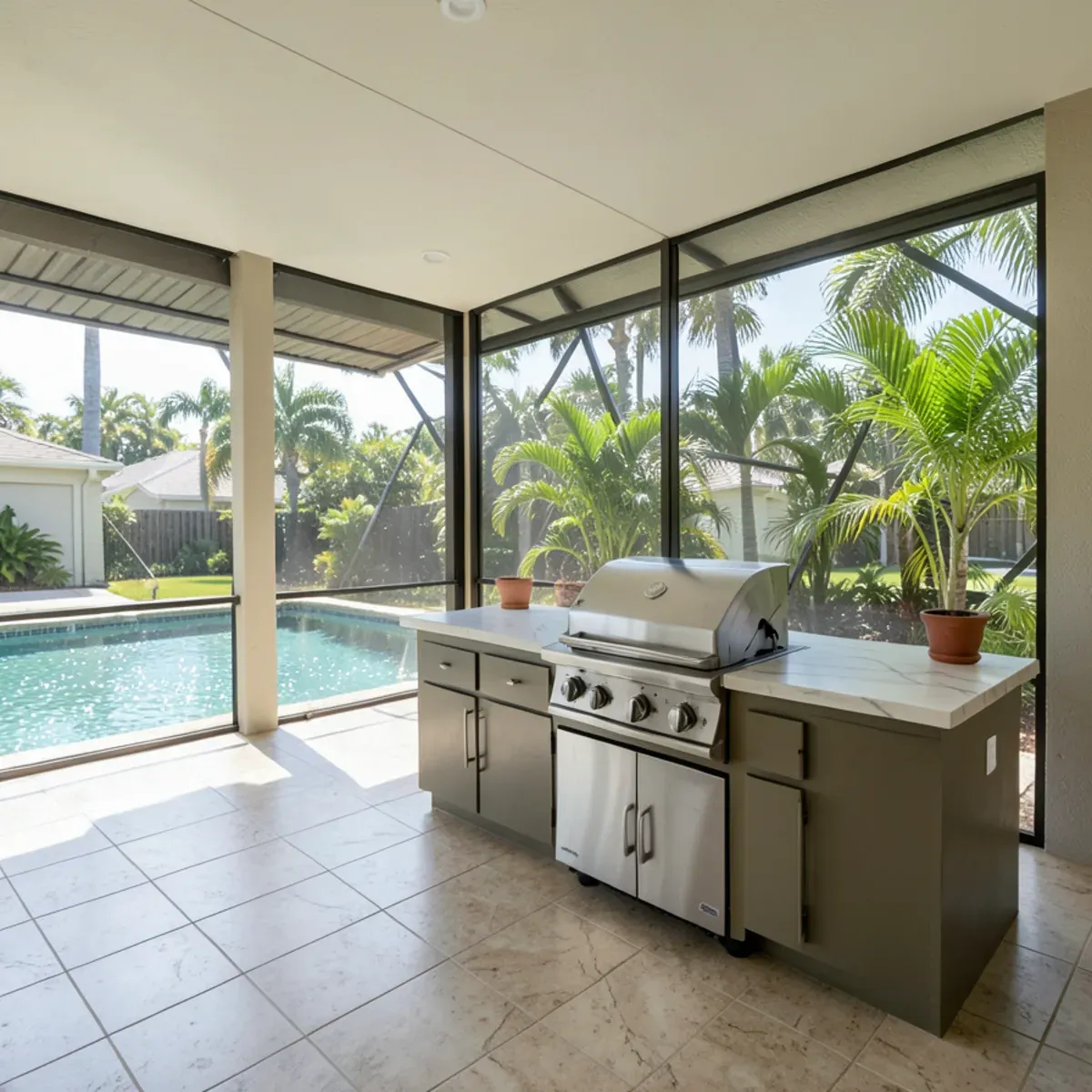
Porcelain countertops resist heat, UV and stains better than quartz and can go outdoors, but the slabs are thin, the pattern on many is printed on the surface, and the edges chip more easily. Quartz is thicker, more forgiving at the edges and simpler to fabricate, but its resin can scorch from hot pans and fade in direct sun. Indoors either works; outdoors, porcelain is the stronger choice.
Porcelain slabs arrived on the countertop scene from the tile world, and they bring a tile's strengths: fired at high temperature, almost nonporous and indifferent to sunlight. Quartz has been the low-maintenance favorite for years. Choosing between them is mostly about where the counter lives and how much you knock its edges.
Here is what each slab is made of, how they compare, why porcelain edges need care, and how the choice plays out in newer Treasure Coast homes.
What Are Porcelain and Quartz Slabs Made Of?
Porcelain slabs are made from fine clays and minerals pressed into large, thin sheets and fired in a kiln. The heat makes them dense, very hard and stable under UV. On many porcelain slabs the marble or stone look is a printed surface layer, so the body underneath is a different color.
Quartz is crushed natural quartz bound with resin and pigment, pressed and cured into thicker slabs. The color runs all the way through, which is why a quartz edge can be shaped into almost any profile and still look right.
Want a straight answer for your kitchen? Call the shop.
Free in-home estimates · Mon–Fri 7:00–4:30 · weekend estimates by appointment
Porcelain vs Quartz Countertops at a Glance
| Feature | Porcelain | Quartz |
|---|---|---|
| Heat | Very heat-resistant | Resin can scorch; use trivets |
| UV and sun | UV-stable; suits outdoor use | Can yellow or fade; many makers exclude outdoor use |
| Stains | Nearly nonporous | Stain-resistant, no sealing |
| Thickness | Thin slabs, often built up at the edge | Standard 2 cm and 3 cm |
| Edges | Chip-prone; limited profiles | Forgiving; most profiles possible |
| Pattern | Often printed on the surface | Color runs through the slab |
| Repairs | Chips are hard to hide | Small chips can often be filled |
| Fabrication | Demanding, higher breakage risk | Straightforward |
Why Do Porcelain Edges Need Extra Care?
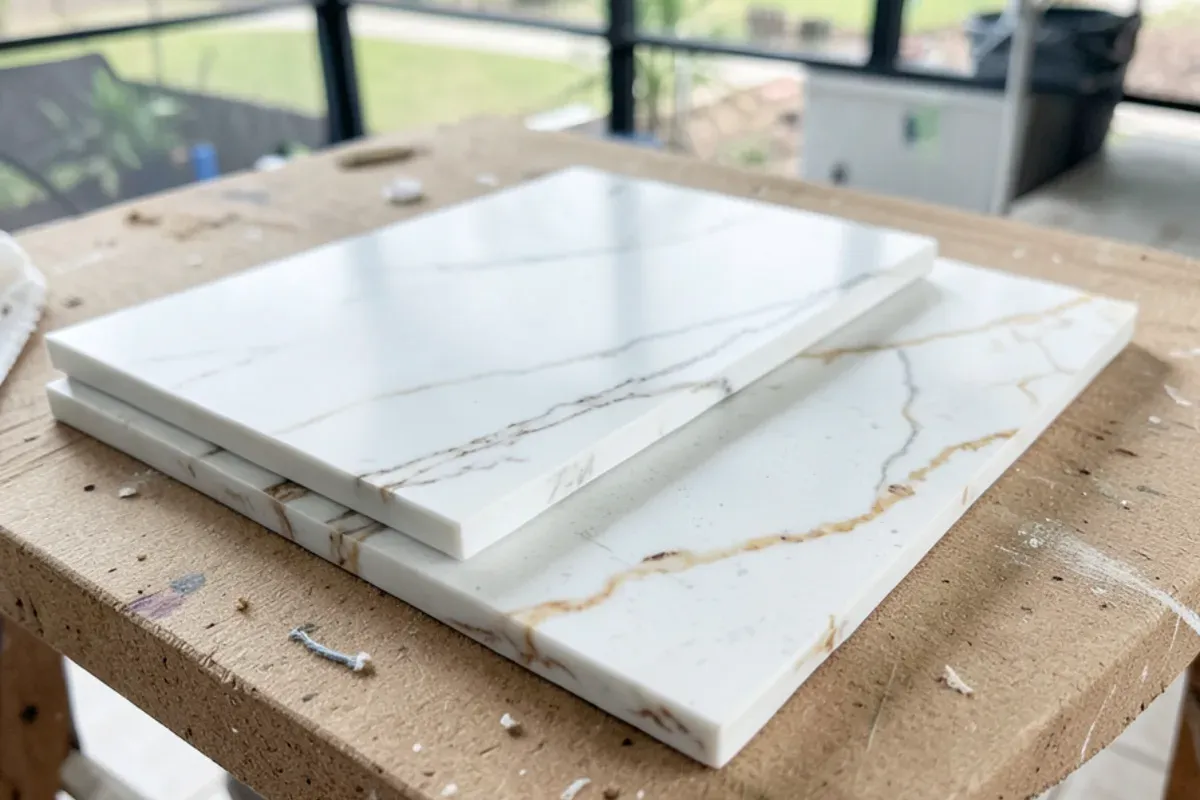
Porcelain is hard but brittle. A heavy pot knocked against a sharp corner can chip it, and because the pattern on many slabs is only on top, a chip exposes a different-colored body underneath. That is why porcelain edges are usually kept simple.
- A small eased edge or a mitered edge that folds a strip down to make the counter look thicker
- No full bullnose or ogee on printed slabs, since shaping would grind through the pattern
- Sink cutouts with generous corner radii, which reduce stress points
- Extra care at the dishwasher and range, where pots and doors hit the edge most
Printed or full-body: what shows at the sink
The sink cutout is where the printed-surface question becomes visible every day. With an undermount sink, the polished inside edge of the opening is exposed, and on a surface-printed slab that edge shows the plain body color rather than the veining. Some owners accept it as a thin line around the bowl. Others choose a full-body porcelain, where the color and some of the pattern carry through the slab, so the cutout edge blends in. Quartz avoids the issue, since its color runs all the way through.
Our porcelain countertops page explains which edge options we suggest and how porcelain is supported over cabinets and overhangs.
Indoors or Out: Where Each One Makes Sense
Outside, the decision is clear. A summer kitchen under a lanai in Port St. Lucie gets afternoon sun, rain blowing through the screen and a grill next to the counter. Porcelain handles all three; quartz resin is the wrong material for a sun-exposed patio.
Indoors, it is closer. The newer gated and golf subdivisions of the West Vero Corridor, along SR-60 near I-95, tend toward flat-panel cabinets and a slim, modern line, which suits a thin porcelain top. Families who are hard on edges, or who want a thick-looking counter with a rounded profile, are usually happier with quartz countertops.
How Fabrication and Cost Compare
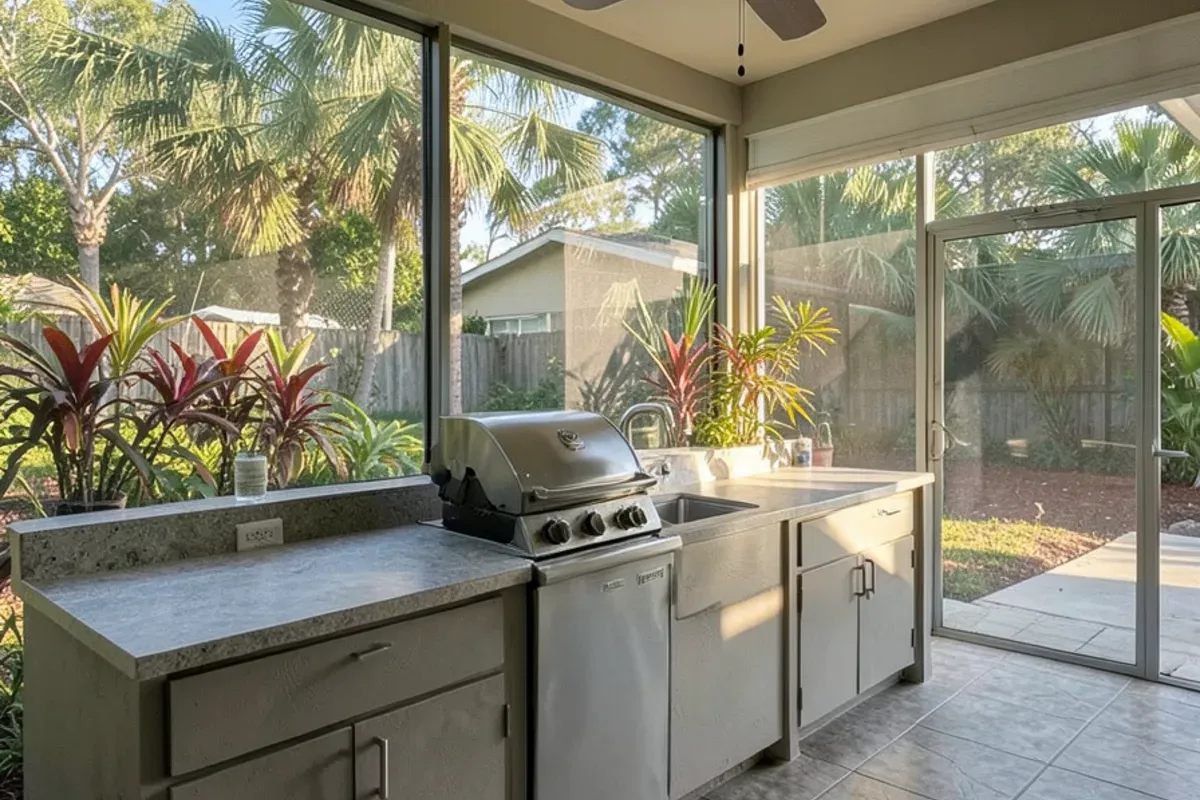
Porcelain asks more of the fabricator. Large thin sheets flex during handling, cutouts must be made carefully to avoid cracking, and a broken piece means another slab. Those realities show up in the quote. Quartz is quicker to cut and edge, so the fabrication share of its price tends to be lower, though slab costs for both vary widely by pattern and maker.
Before You Choose: Six Questions for Any Porcelain Slab
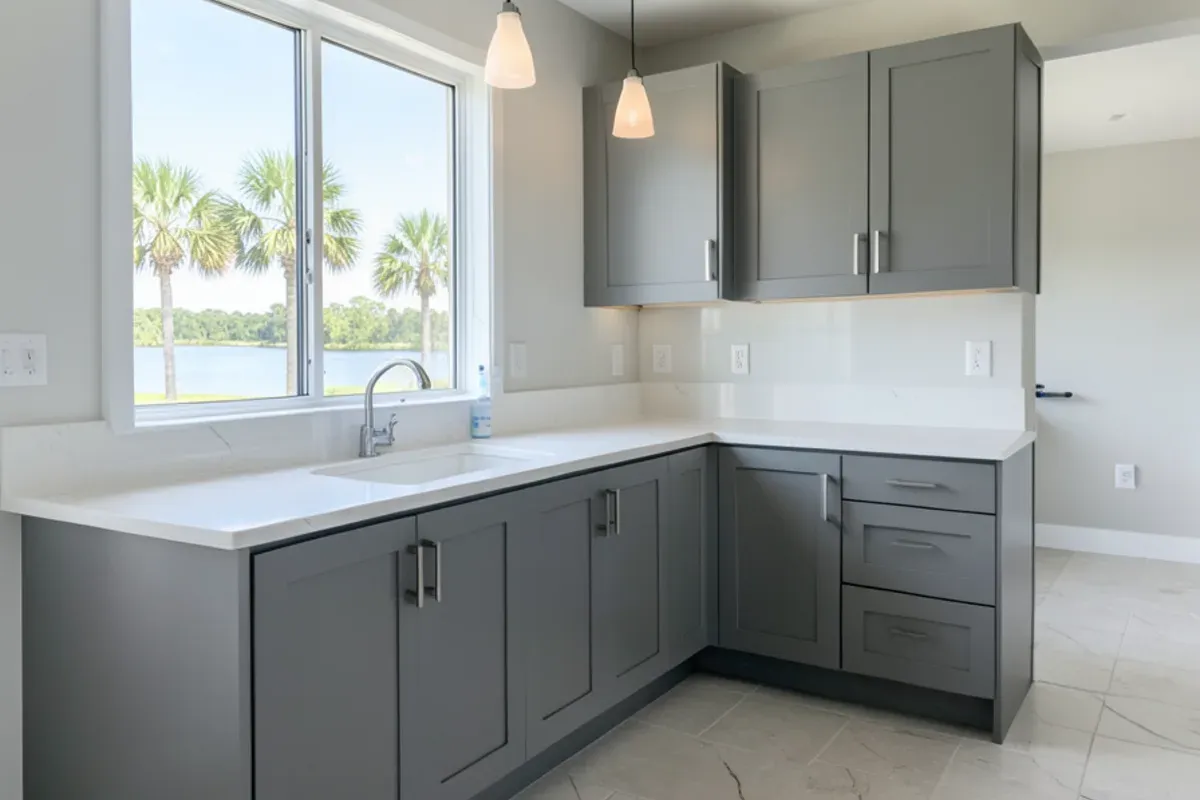
Porcelain is less standardized than quartz, so two slabs that look alike in a sample can behave differently on your cabinets. Settle these before you commit:
- Is the pattern printed on the face, or does the color run through the body?
- What thickness does the slab come in, and will the visible edge be built up with a mitered strip to look heavier?
- Where will the counter live: an indoor kitchen, a covered lanai, or open sun beside a pool?
- How flat are the cabinets or the outdoor block base? A thin slab needs full, even support underneath.
- Is there seating overhang, and how will it be carried? Thin porcelain needs more support than thicker quartz.
- Which sink and cooktop are going in, and how will the cut edges of those openings look?
Base flatness matters more than people expect. Many homes on the older 1960s-platted lots in Port St. Lucie have cabinets that have settled over the decades, which a 3 cm quartz top bridges more forgivingly than a thin porcelain sheet. New builds in master-planned areas such as Tradition usually start flat. At the estimate we run a level along those boxes and say plainly whether porcelain suits them.
From Our Shop: Handling Thin Slabs
When we move porcelain, it travels supported along its full length, never carried flat by the ends. Thin sheets are strong in use once they are glued down to a flat base, but they are vulnerable on the way there. That is also why we pay close attention to how flat the cabinets are before templating a porcelain job.
We also talk honestly about edges at the estimate. If someone in the house tends to bang pots on the counter edge, quartz is the more forgiving choice, and we would rather say so than repair a chipped porcelain corner later.
Layout is the other job that changes with porcelain. A printed pattern is made from a limited set of digital faces, so on a long perimeter run the same distinctive vein can turn up twice. When we lay the pieces out, we look for those repeats and place them where they will not sit side by side. Quartz with a marble-style vein has a version of the same issue; natural stone does not, since no two areas of a slab are alike.
Questions We Hear About This
Can you cut directly on porcelain countertops?
You can, but you should not. Porcelain is harder than steel knife edges, so it will dull your knives quickly and can show faint marks from ceramic or stone knives. A cutting board protects both the knife and the surface. Quartz is also best treated with a board, since a sharp blade can mark the resin over time.
Does porcelain need sealing?
No. Fired porcelain is close to nonporous, so oils, wine and coffee stay on the surface and wipe away. That makes it attractive for outdoor kitchens on the Treasure Coast, where rain, pollen and grill grease would soak into a stone that is not sealed. Quartz also needs no sealing, so on this point the two are equal indoors.
Is porcelain lighter than quartz?
Generally, yes, because porcelain slabs are thinner. That can help on upper floors and in condos where slabs travel in an elevator, though the large sheet size still needs careful handling. Quartz in 2 cm or 3 cm is heavier per square foot, and that weight is one reason it feels so solid at the edge.
Can a chipped porcelain countertop be repaired?
Small chips can be filled with a color-matched resin, but the repair is harder to hide on porcelain than on quartz. On printed slabs the chip exposes the plain body beneath the pattern, so the fill has to imitate the surface design. That is the main reason we steer heavy-use edges, such as the run beside a dishwasher, toward simple profiles and careful placement.
Can porcelain work on an island with bar seating?
Yes, with more support than quartz would need. A 3 cm quartz top can typically span roughly 10 to 12 inches past the cabinets without help, while a thin porcelain slab relies on brackets, a support panel or a steel frame beneath the seating side. Plan that support before the cabinets are finished, since it can affect the island's construction. We mark the overhang depth and support type on the template.
The Bottom Line
Choose porcelain for sun, heat and outdoor use, and accept simpler edges and a bit more care around them. Choose quartz for a forgiving, thicker counter indoors where nothing hot or sunny threatens the resin.
From first visit to walk-through, every job follows the steps on our Fort Pierce countertop installation page. Give us a call and we'll set porcelain and quartz side by side in your kitchen or on the lanai, free.